
November 26, 2026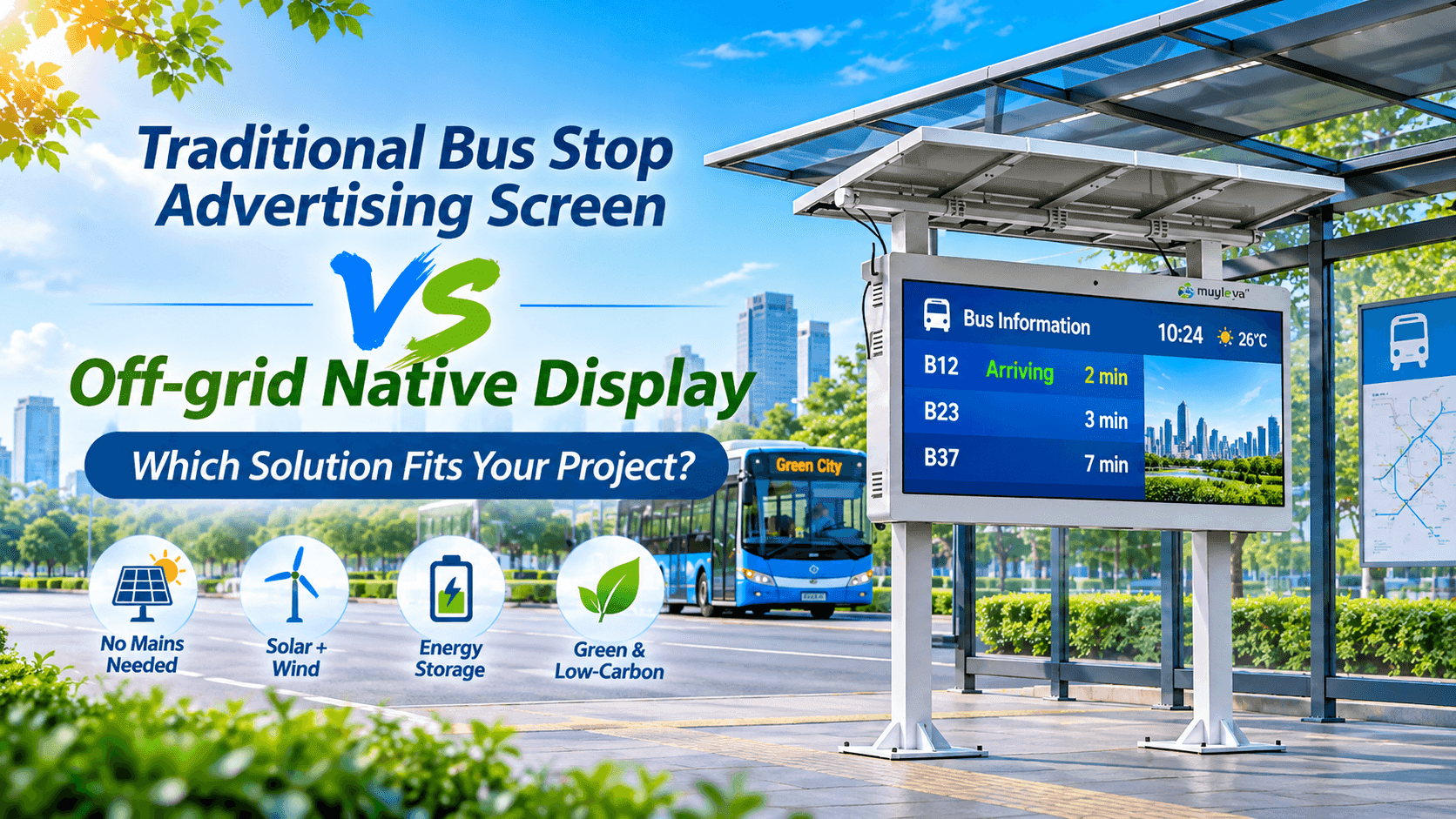
Traditional Bus Stop Advertising Screens vs. Off-grid Native Display: Which Outdoor Display Solution Is Right for Your Project?
Traditional Bus Stop Advertising Screens vs. Off-grid Native Display: Which Outdoor Display Solution Is Right for Your Project?
With the development of smart transportation and digital out-of-home advertising, LED displays are becoming important information platforms at bus stops, urban transportation hubs, and public waiting areas. From commercial advertising and public service announcements to bus route information, digital display technology is transforming how information is delivered at traditional bus stops.
However, not every bus stop has convenient access to electricity. In suburban areas, rural communities, tourist destinations, and remote transportation locations, power connections, electrical wiring, and ongoing maintenance can increase project costs.
So, what are the differences between traditional bus stop advertising screens and Off-grid Native Display? For projects where grid access is difficult, is there a more flexible display solution?
This article explores the differences in power supply, installation requirements, energy management, and application scenarios.
1. What Is a Traditional Bus Stop Advertising Screen?
A traditional Bus Stop Advertising Display is a digital display device installed at bus shelters, bus stops, and surrounding public areas. It is primarily used for commercial advertising and public information delivery.
Compared with traditional static advertising lightboxes, LED displays and digital signage can present dynamic videos, images, text, and other digital content, providing greater flexibility for advertising and information communication.
Main applications of traditional bus stop advertising screens include:
Commercial Advertising: Displaying brand promotions, product advertisements, and special offers.
Public Transportation Information: Presenting bus routes, stop information, and travel notices.
Public Service Announcements: Delivering civic campaigns, public safety messages, and community information.
Public Information Display: Showing weather updates, city announcements, and other public service information.
Traditional bus stop advertising screens generally rely on grid electricity and are suitable for bus stops with well-developed electrical infrastructure and convenient access to power.
2. What Power Supply Challenges Do Traditional Bus Stop Advertising Screens Face?
In central urban areas, bus stops usually have relatively well-developed electrical infrastructure, allowing traditional advertising screens to operate through conventional power supply systems.
However, when projects expand to suburban areas, rural roads, and remote locations, power supply can become an important consideration.
2.1 Limited Access to Electricity
Some bus stops are located far from existing power infrastructure and do not have convenient electrical connections. Additional power lines may need to be planned before digital advertising screens can be installed.
2.2 Additional Installation and Wiring Costs
When an installation site is far from an existing power source, the project may require additional cable installation, pipeline construction, and electrical infrastructure. These factors can increase initial investment and construction complexity.
2.3 Limited Deployment Flexibility at Remote Bus Stops
In rural areas, tourist roads, and suburban locations, some bus stops lack adequate electrical infrastructure. Traditional grid-powered solutions may therefore face installation limitations.
2.4 Continuous Electricity Is Required for Long-Term Operation
Traditional outdoor digital advertising screens require a stable electricity supply. For advertising operators managing multiple distributed bus stops, power access, electricity expenses, and equipment maintenance are important operational considerations.
Therefore, for bus stops where grid access is difficult or wiring costs are high, more flexible power supply options can provide practical value.
3. What Is an Off-grid Native Display?
Off-grid Native Display is an integrated wind-solar-storage-display LED solution developed by Muyleva.
Unlike traditional display equipment that relies on external municipal grid electricity, Off-grid Native Display integrates photovoltaic power generation, micro-wind power generation, energy storage, and an LED display system into one integrated solution. It enables independent power generation, energy storage, and display operation.
Its core systems include:
3.1 Solar Photovoltaic System
Photovoltaic panels convert solar energy into electricity to supply power to the display system.
3.2 Micro-Wind Power Generation System
Micro-wind turbines provide additional energy input and complement solar power generation, improving the flexibility of the overall energy supply.
3.3 Energy Storage System
The battery system stores electricity generated by the energy generation components and supplies power to the display when sunlight or wind is insufficient.
3.4 LED Display System
The LED display presents commercial advertisements, public information, traffic notices, and other digital content.
The standard model does not require connection to the municipal power grid. Its configuration can be adjusted according to local sunlight conditions, wind resources, battery capacity, and display power consumption, providing a new display solution for outdoor locations where grid access is difficult.
4. What Are the Differences Between Traditional Bus Stop Advertising Screens and Off-grid Native Display?
Both traditional bus stop advertising screens and Off-grid Native Display can be used for outdoor advertising and public information delivery. However, they differ significantly in power supply, installation requirements, energy management, and suitable applications.
4.1 Different Power Supply Methods
Traditional bus stop advertising screens generally rely on grid electricity and require an external power system to provide continuous energy for the LED display.
Off-grid Native Display uses an integrated wind-solar-storage-display architecture that combines photovoltaic power generation, micro-wind power generation, and energy storage. Its independent energy system supports power generation, energy storage, and display operation. The standard model does not require connection to the municipal power grid.
4.2 Different Levels of Grid Dependence
Traditional bus stop advertising screens require suitable electrical access. If the installation site is far from an existing power source, additional power lines may be necessary.
Off-grid Native Display does not depend on municipal grid electricity. It provides another deployment option for outdoor bus stops in areas with no electricity, weak grid infrastructure, or difficult power access.
4.3 Different Installation Conditions and Construction Requirements
When installing traditional bus stop advertising screens, project planners need to consider power connections, electrical wiring, and on-site construction conditions. Sites far from existing electrical infrastructure may require additional cable installation and supporting electrical work.
Off-grid Native Display integrates photovoltaic panels, micro-wind power generation, and energy storage. Under suitable installation conditions, it can reduce the need for external grid connections and long-distance power wiring, offering greater installation flexibility for remote bus stops and outdoor advertising projects.
4.4 Different Energy Management Methods
Traditional bus stop advertising screens mainly operate through external electricity systems. Their energy management generally focuses on electricity consumption and display operation.
Off-grid Native Display requires integrated management of power generation, energy storage, and energy consumption in addition to display management. It supports light control, time control, remote cloud monitoring, brightness adjustment, and energy monitoring, helping operators understand equipment status and energy usage.
4.5 Different Application Scenarios
Traditional bus stop advertising screens are more suitable for city-center locations and bus stops with well-developed electrical infrastructure and convenient grid access. They can be used for commercial advertising, brand promotion, and public information display.
Off-grid Native Display is more suitable for suburban areas, rural roads, tourist routes, and remote transportation locations where grid access is difficult. It can display bus route information, commercial advertisements, public service announcements, and other public information.
Overall, traditional bus stop advertising screens and Off-grid Native Display are not simply competing replacement products. Traditional solutions remain suitable for projects with convenient electricity access, while Off-grid Native Display provides a new option for outdoor display projects with limited power infrastructure.
5. What Value Does Off-grid Native Display Bring to Bus Stops and Transportation Advertising?
For bus stop advertising operators, outdoor advertising contractors, and smart transportation system integrators, Off-grid Native Display can expand the potential deployment locations of digital advertising screens.
5.1 Expanding Advertising Deployment to Remote Bus Stops
At rural bus stops, suburban transportation points, and remote road locations, conventional power access may be inconvenient. Wind-solar-storage-display technology offers additional possibilities for deploying outdoor advertising screens in these areas.
5.2 Reducing Certain Power Wiring Requirements
Off-grid Native Display uses its integrated energy system to operate independently. Under suitable project conditions, it can reduce the need for municipal grid connections and long-distance power wiring, simplifying certain aspects of construction.
5.3 Supporting Diverse Digital Information Displays
In addition to commercial advertising, Off-grid Native Display can present bus route information, public safety messages, weather updates, public service announcements, and other urban service information to meet the needs of different transportation locations.
5.4 Supporting Remote Management and Energy Monitoring
The equipment supports light control, time control, remote cloud monitoring, brightness adjustment, and energy monitoring. These functions help operators understand equipment status and manage the display according to actual operating requirements.
6. Which Bus Stop Display Solution Is Right for Your Project?
When selecting a digital display solution for bus stops, it is important to consider more than the display itself. Installation location, power availability, daily operating hours, display size, brightness requirements, and project operating costs should all be evaluated.
Traditional bus stop advertising screens may be more suitable when:
The bus stop is located in a central urban area.
Stable grid electricity is readily available.
Established power supply and wiring infrastructure is already in place.
The project focuses on conventional advertising display deployment.
Off-grid Native Display may be more suitable when:
The bus stop is located in a suburban or remote area.
Stable grid access is unavailable or difficult to obtain.
Long-distance power wiring would involve high construction costs.
The project requires an independent wind-solar-storage power solution.
Digital display equipment needs to be deployed in outdoor areas with limited electrical infrastructure.
For actual projects, system configuration should be determined according to local sunlight conditions, wind resources, energy storage capacity, display power consumption, and daily operating hours to ensure that energy supply matches display requirements.
7. Muyleva: A New Off-grid Display Option for Outdoor Digital Advertising
Muyleva specializes in integrated wind-solar-storage-display solutions. Its Off-grid Native Display combines photovoltaic power generation, micro-wind power generation, energy storage, and LED display technology in one integrated system.
Through its independent energy system, the equipment can operate without relying on municipal grid electricity, providing a new deployment option for locations where conventional outdoor displays cannot easily access power.
For bus stops, rural roads, suburban transportation locations, and other outdoor advertising projects, Muyleva aims to expand the application possibilities of digital displays through integrated wind-solar-storage-display technology.
Where there’s wind and sun, there’s a screen.
If you are planning a bus stop advertising screen, outdoor digital signage project, or public information display in a remote area, contact Muyleva to learn more about the Off-grid Native Display solution.